
-
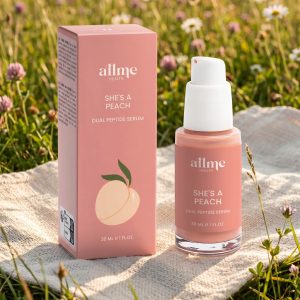 1 × $48.00
Subtotal $48.00

Two actives. One job: helping skin look firmer, smoother, and more bouncy. Here’s the science behind the peptide-and-amino-acid pairing at the heart of our dual peptide serum — and why we chose each one.
Firmness is a collagen story. As skin matures, the collagen and elastin scaffolding that keeps it springy starts to thin and slacken — and that’s what reads, in the mirror, as fine lines and a loss of “snap.” The smartest way to support it isn’t a single hero ingredient; it’s a pairing that works on the structure from two complementary angles. That’s exactly how we built She’s a Peach.
The two stars are Hexapeptide-11, a fermentation-derived signaling peptide, and Dipalmitoyl Hydroxyproline, a lipid-wrapped form of collagen’s own signature amino acid. One sends the message; the other delivers the building block. Let’s meet them.
Hexapeptide-11 is a true peptide — a precise six-amino-acid sequence (Phe-Val-Ala-Pro-Phe-Pro). It isn’t synthesized in a harsh chemical bath; it’s produced through yeast fermentation biotechnology, then purified by filtration and chromatography to isolate the exact peptide.1 It’s the same sequence found in some of yeast’s own resilience proteins, including the heat-shock protein hsp70.1
It behaves like a message to your skin cells. In the research literature, Hexapeptide-11 has been shown to increase collagen synthesis and upregulate growth factors along with matrix and heat-shock proteins — the cellular machinery skin uses to rebuild and stay resilient.2
And it’s not just lab theory. In a clinical use study, Hexapeptide-11 was applied to half the face of healthy volunteers twice daily — and by week four, treated skin showed improved elasticity and a better deformation response (how well skin springs back).2
A half-face design is a lovely thing, because each person acts as their own control — the untreated side is the comparison. That’s why this kind of result is more persuasive than a simple before-and-after.
Here’s the elegant part. Hydroxyproline is the amino acid that is essentially unique to collagen — it’s the structural signature of the protein we’re trying to support. Dipalmitoyl Hydroxyproline takes that amino acid and wraps it in two palmitic-acid (fatty) chains.3 Those fatty “tails” make it oil-loving, so it partners beautifully with the skin’s own lipid barrier — a smart delivery trick that the best modern peptides also use.
It’s a multitasker. As formulated in our serum it’s understood to work in three complementary ways: supporting collagen-fiber remodeling and contraction, helping shield elastic fibers from enzymatic breakdown, and scavenging free radicals.4 Firming, protecting, and defending — at once.
It also has the kind of in-vivo testing that makes a formulator smile. In the manufacturer’s clinical evaluation, Dipalmitoyl Hydroxyproline delivered a 32% reduction in the appearance of wrinkles versus placebo.4 It’s no surprise it shows up in some of the most respected firming and eye treatments on the market.5
One active sends the firming signal. The other supplies collagen’s own raw material — and is built to actually get where it’s going.
This is the logic behind the “dual” in dual serum. Skin firmness depends on both signaling (telling cells to build) and substrate plus protection (giving them material to build with, and defending what’s already there). Hexapeptide-11 leans into the first; Dipalmitoyl Hydroxyproline leans into the second. Together they approach the same goal — visibly firmer, smoother, bouncier-looking skin — from two directions rather than one.
And because both are designed with delivery in mind — one fermentation-purified to a clean low-molecular-weight peptide, the other lipid-wrapped to travel with your barrier — this isn’t a formula relying on actives that just sit on the surface.
She’s a Peach pairs a clinically studied firming peptide with a clever, collagen-derived amino-acid active built to actually penetrate. It’s a thoughtful, science-led approach to one of skincare’s most-wanted results — firmer, smoother, more resilient-looking skin — and we’re genuinely proud of it. Give it a few weeks of consistent use and let your skin show you.
Allme Health products are cosmetics intended to improve the appearance of skin; they are not drugs and are not intended to diagnose, treat, cure, or prevent any disease. Individual results vary. The Hexapeptide-11 clinical reference is a small half-face study, and the Dipalmitoyl Hydroxyproline wrinkle figure is from manufacturer testing — both are encouraging, and we share them transparently. This article is general education, not individual medical advice.
“Peptide” has become one of the most-used words on a skincare label. But two questions decide whether a peptide cream is worth your money: can the peptide get into your skin, and once it’s there, does it measurably do anything? Here’s what the research actually shows.
Peptides are short chains of amino acids — the same building blocks that make up the proteins in your skin. The appeal is intuitive: certain peptides act as biological “messages” that can tell skin cells to make more collagen, calm inflammation, or behave the way younger skin does.6 That’s the marketing promise. The clinical reality is more interesting, and more honest, than most product pages let on.
At Allme, we think you should understand an ingredient before you build a routine around it. So let’s separate the chemistry from the copywriting.
Cosmetic peptides are usually grouped by how they’re meant to work. A 2025 review in the International Journal of Molecular Sciences describes four broad categories:1
Those mechanisms are real in the lab. The catch is that all of them depend on one thing the label rarely mentions: the peptide has to physically reach the living layers of your skin first.
Your skin’s outermost layer, the stratum corneum, is a lipid-rich barrier built specifically to keep things out. Most cosmetic peptides are water-loving (hydrophilic) and relatively large — exactly the profile that struggles to cross an oily barrier. Reviewers are blunt about this: peptides are “not inherently designed to penetrate the skin,” and their size and water-affinity are significant obstacles to delivery.1
How big a problem is it? Look at the published penetration data for acetyl hexapeptide-8 (Argireline), and you’ll see why no honest clinician promises miracles:
Those first two numbers come from different labs studying the same peptide — and they disagree by two orders of magnitude. That’s the honest state of the science: penetration is real but highly variable, and it depends enormously on how the product is made. When researchers used tape-stripping to map where the peptide ended up, the highest concentrations stayed in the outermost layers of the stratum corneum, with less and less reaching deeper.1
The delivery of hydrophilic macromolecules such as peptides through the skin is difficult — and for some peptides, reaching the deeper dermis through a cream may simply not happen.1
This has a practical consequence worth saying plainly: for the “botox-like” peptides specifically, the published in-vivo studies have not confirmed that topical application actually relaxes facial muscles the way the marketing implies.1 Any visible benefit is more likely happening at the surface — hydration, smoothing, light-reflection — than deep at the neuromuscular junction.
If raw penetration is the bottleneck, formulation is the lever. The evidence points to a few delivery strategies that meaningfully improve how much peptide gets in:
Attaching a fatty acid to a peptide makes it more oil-soluble, so it slips through the lipid barrier more easily. This is exactly why palmitoyl pentapeptide-4 (Matrixyl) penetrates better than the bare KTTKS peptide it’s built from — the palmitic-acid tail does the heavy lifting. Industry safety reviewers note that the charged, water-loving parent peptide struggles to cross intact skin until that fatty acid is added.4
The type of cream base matters. For acetyl hexapeptide-8, oil-in-water and multiple water-in-oil-in-water emulsions delivered significantly more peptide than a simple water-in-oil base, and a slightly acidic formula improved the peptide’s solubility and movement into the epidermis.1 A well-formulated peptide cream and a poorly formulated one can contain the “same” active and behave completely differently.
A 2026 systematic review notes that peptide delivery to target cells “may be enhanced by lipid conjugation or nanoparticle” systems — the direction much of current formulation research is heading.5
Here’s where we have to be careful — and where Allme will give you the caveat most blogs skip.
The largest recent synthesis, a 2026 systematic review and meta-analysis in Frontiers in Medicine, pooled 19 randomized controlled trials covering 1,341 participants (average age ~50). Peptides significantly improved skin hydration and brightness, with a modest but statistically significant effect on wrinkle reduction (mean difference 0.27, p = 0.04). Effects on elasticity and skin density were inconsistent, and the peptides were very well tolerated.5
In that meta-analysis, roughly 92% of participants were taking oral collagen peptides — only about 8% used topical formulations.5 The strongest wrinkle signal came from oral polypeptides (mean difference 1.5, p = 0.01), not creams. So the single biggest pooled dataset tells us more about peptide supplements than peptide creams. The topical evidence base is genuinely thinner.
That said, the topical evidence is not empty — for a few specific peptides it’s reasonably solid:
Notice the pattern: the peptides with the better clinical track record (the palmitoyl signal peptides) are also the ones engineered to penetrate. Delivery and efficacy travel together.
You don’t need a chemistry degree to make a smarter choice. A few honest filters:
Topical peptides are a legitimate, well-tolerated category with real — if modest — anti-aging benefits, strongest for a handful of penetration-optimized signal peptides. They are not magic, the deeper claims often outrun the data, and the single largest body of evidence actually sits with oral peptides rather than creams. A good peptide cream is a reasonable, low-risk addition to a routine. It is a supporting actor, not the lead.
If you’d like a routine built around ingredients that match your skin and your goals — and a clinician who’ll tell you when something isn’t worth it — that’s exactly what we do at Allme.
This article is for general educational purposes and reflects the published literature as of 2026; it is not individual medical advice and does not establish a clinician–patient relationship. Cosmetic peptides are regulated as cosmetics, not drugs, and are not intended to diagnose, treat, cure, or prevent any disease. Talk with a licensed clinician about what’s appropriate for your skin.
Schedule Your Evaluation
Sign up to be the first to know